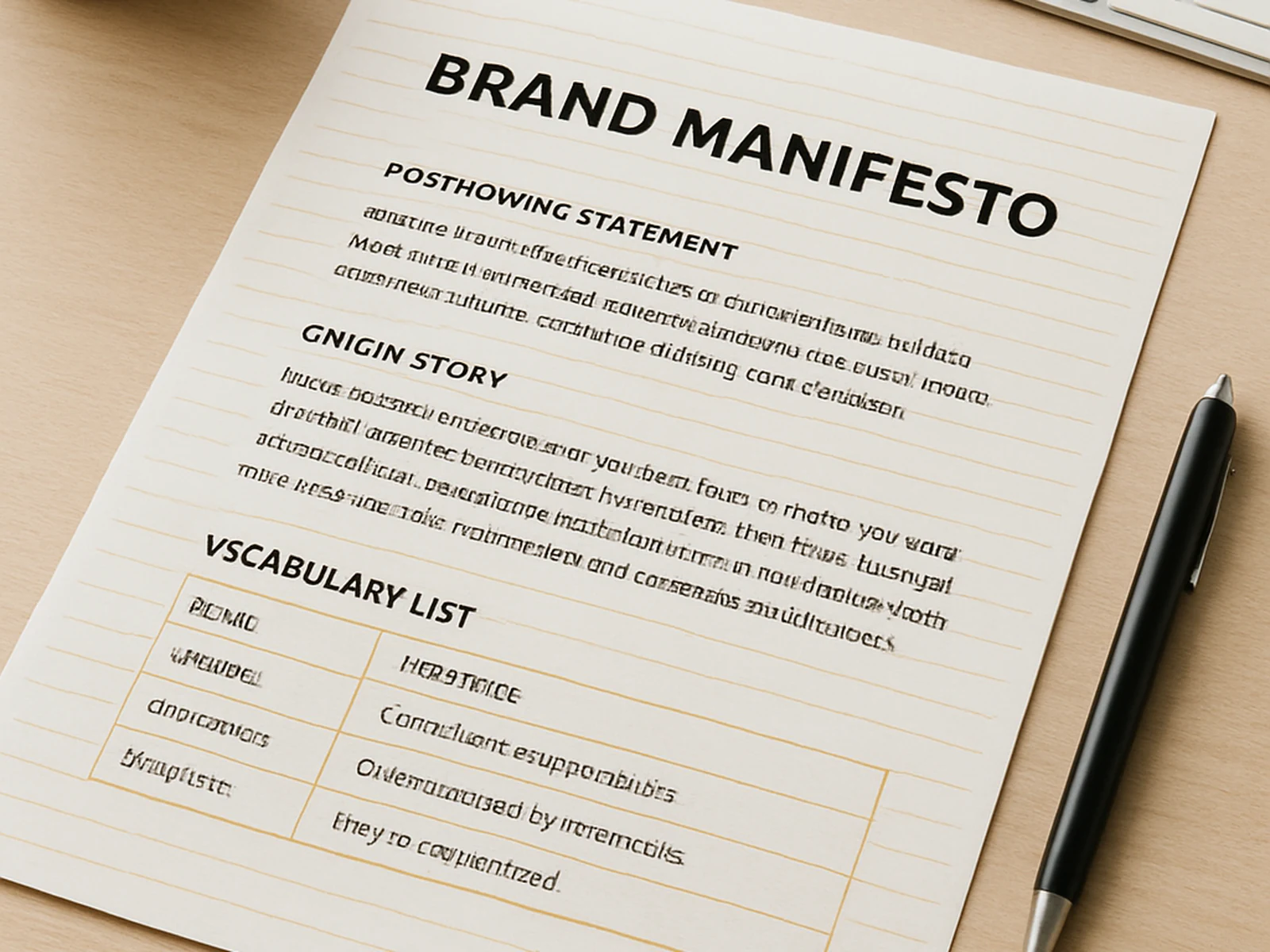
The documents that make everything else faster
A brand manifesto is not a mission statement. It is not a tagline. It is the complete articulation of what you believe, who you believe it for, why you are different from the alternatives, and what you stand against. It exists so that every future piece of content -- every email, every landing page, every social post, every pitch deck -- can be written faster, by anyone, without losing coherence.
The brand voice guide is the operating manual that follows. It specifies vocabulary you use and vocabulary you avoid, sentence rhythm, the level of formality across different contexts, how to handle topics your category handles badly, and examples of on-brand and off-brand content for each context type.
The positioning statement is the compressed argument: who you serve, what problem you solve, what makes your solution different, and what outcome the customer gets that they cannot get elsewhere. It takes two to four drafts to get right because vague positioning produces vague statements, and the process of writing a precise one surfaces the gaps in the positioning itself.
The origin story is last. Not because it is least important, but because it should follow naturally from everything else. An origin story that does not connect to the positioning, voice, and beliefs of the brand feels disconnected. Written last, it can do the full job.
- Brand manifesto (1,500-2,500 words)
- Positioning statement (one page)
- Brand voice guide with examples
- Origin story (600-900 words)
- Messaging framework for each audience segment
- Do/Do Not vocabulary list
Who this is for
This service works best for companies at an inflection point: newly funded, rebranding after an acquisition, launching into a new market, or simply finding that their existing messaging is producing friction instead of clarity. It also works for founder-led businesses where the brand voice is currently entirely in the founder s head.